1. Introduction
"Business Shutdown Enforcers" (hereinafter referred to as BSEs) is a concept firstly raised in China, referring to (a certain group of) individuals who specialize in devising strategies for certain businesses or enterprises to evade or mitigate debt obligations and legal consequences. These businesses are typically found in sectors that promote prepaid consumption, such as beauty and wellness services, fitness centers, education or training institutions. BSEs assist these businesses by designing promotional campaigns to attract large amounts of prepayment from consumers shortly before the business shuts down "overnight". After the closure, they help transfer the business premises or change the legal representative through various means, distancing the original operators from financial and/or legal liability. The Enforcers then take over the handling of consumer complaints or potential legal actions arising from the closure
| [1] | Lei, Y., and Yunshi, L. Store Closure Give Rise to a New "Profession" (Bidian Cuisheng Xin"Zhiye"), Faren Magazine. 2024, (07), 80-82. |
[1]
. The irresponsible activities of BSEs put customers’ rights and the prepayment at grave stake.
The term "Business Shutdown Enforcers" is adopted, in this paper, rather than other alternatives such as "Professional Store Closers". This choice reflects the essential characteristics of the actors involved. These individuals or groups are not merely engaged in closing down stores or small businesses. Rather, they act as intermediaries who design and implement shutdown strategies primarily to help original owners evade debts. Their core function lies in enforcing tailored schemes that facilitate the transfer or concealment of liabilities under the guise of business closure, rather than simply terminating commercial operations. The term "Business Shutdown Enforcers" thus better captures both the operational and the intermediary nature of their activities.
To regulate and eliminate BSEs, civil laws and commercial laws are mostly used to address these individuals. It is highlighted in the 2025 Work Report of the Supreme People's Court, under the section titled "Upholding Strict and Impartial Justice to Safeguard People's Livelihood", the case adjudicated by the Fengtai District People’s Court of Beijing, "A Business Shutdown Enforcer Held Civilly Liable for Deregistering a Company Using False Materials" (also known as the first civil case in China concerning BSEs), was explicitly referenced
. This case represents a concrete and effective implementation of civil law mechanisms to regulate the conduct of Business Shutdown Enforcers.
However, regulating BSEs solely through civil and commercial law is far from sufficient. The increasing number of BSEs has, in practice, turned this role into a de facto occupation, giving rise to an informal industry chain. This phenomenon has significantly disrupted the authority and effectiveness of social governance mechanisms, corporate compliance structures, and the credibility of social credit systems. If we make the presumption that BSEs are allowed to continue unchecked, the social responsibility of businesses will be further eroded, and the integrity and authority of the social credit system as a whole will be undermined. As the final safeguard of social order
, criminal law must be considered as a necessary tool to intervene and impose regulatory boundaries on such actors. The conduct of BSEs may, in fact, be criminalized under the
Criminal Law of the People's Republic of China by applying relevant existing offences. Moreover, when the operational patterns (or mode) of BSEs are examined through the framework of specific criminal offences, the analysis of elements of crime becomes clearer. This approach enables a clearer identification of criminal liability and facilitates the development of doctrinal consistency in legal enforcement.
In addition to examining how the conduct of BSEs may be addressed under Chinese Criminal Law, this paper will also adopt a comparative perspective to analyze and summarize how similar groups are regulated through criminal law in other jurisdictions. Furthermore, the paper will briefly explore the extent to which such actors, when abstracted as certain organized groups or individuals, may justify criminal regulation in other legal systems, as well as the normative boundaries and practical limitations of such regulatory efforts.
2. Business Shutdown Enforcers in China: Toward Criminal Liability
The necessity of regulating Business Shutdown Enforcers (BSEs) arises fundamentally from the hierarchical relationship between civil law and criminal law within the legal governance structure. In principle, civil law and criminal law each possess distinct regulatory scopes and protected legal interests. However, in addressing the phenomenon of BSEs, these two legal frameworks overlap. When dealing with social issues requiring legal intervention, it is essential to evaluate which sphere of law, civil or criminal, should take precedence.
2.1. Hierarchy of Regulating BSEs in Legal Sphere
As previously mentioned, criminal law serves as the ultimate safeguard for social governance
| [4] | Yanhong, L. Theoretical Adaptation of Criminal Law to Societal Development: Five Critical Relationships to be Managed (Xingfalilun Yin Yingshidaifazhan Xv Chulihao Wuzhongguanxi), Oriental Law. 2020, (2), 6-19. |
[4]
, typically invoked only when other measures prove insufficient. Thus, deploying criminal law to regulate societal issues demands cautious consideration
| [5] | Hongchang, Z. A Study on the Moderation of Criminal Liability in Mixed Civil-Criminal Cases (Tixiyuwenti Jiaorongxia Minxingjiaocha’anjiande Qianyixing Yanjiu), Journal of People’s Public Security University of China (Social Sciences Edition). 2023, 39(4), 15-23. |
[5]
. A singular approach, relying exclusively on either civil or criminal law, is often inadequate for comprehensive social governance. Conversely, indiscriminately applying criminal law to all societal problems may dilute its authoritative deterrent effect, undermine its integrity and ruin the principle of last resort
of criminal law. In the specific context of regulating BSEs, a blended governance approach that integrates both civil and criminal law is particularly appropriate. From the perspective of foundational principles underpinning each area of law, addressing BSEs through both civil and criminal mechanisms effectively intersects two key principles: the principle of good faith under civil law, and the principle of legality in criminal law. Additionally, the inclusion of China's first judicial case against Business Shutdown Enforcers in the "Safeguarding People's Livelihood" section of the 2025 Supreme People's Court Work Report
further implies and highlights the necessity of legal intervention. From this perspective, the activities of BSEs evidently threaten core values such as people's livelihood and corporate social responsibility, which are values fundamentally protected by civil law. Therefore, effective regulation and deterrence through appropriate legal mechanisms, particularly involving criminal law, become essential to preserving these fundamental societal interests.
Returning to the core issue addressed in this section, it is essential to clarify why relying solely upon civil (and commercial) laws is inadequate for the regulation of newly emerged Business Shutdown Enforcers. The justification for escalating the regulation of BSEs into the criminal sphere lies primarily in the fact that the most attractive aspect of their services to businesses may not simply be the avoidance of debt obligations
| [8] | Hongxiang, L., and Xue P. Study on the legal examination and governance strategy of the phenomenon of ''Professional Store Closers'' (''Zhiyebidianren'' Xianxiangde Falvshenshi Yu Zhilicelue Yanjiu), Dispute Settlement. 2024, 10(10), 86-92.
https://doi.org/10.12677/ds.2024.1010409 |
[8]
. Instead, their core selling point often includes aiding businesses in evading criminal liabilities. Specifically, during the process of implementing their services, the conduct of BSEs frequently constitutes elements of criminal offenses, such as fraud or contractual fraud, but in practical terms, criminal prosecutions against BSEs remain notably rare
| [8] | Hongxiang, L., and Xue P. Study on the legal examination and governance strategy of the phenomenon of ''Professional Store Closers'' (''Zhiyebidianren'' Xianxiangde Falvshenshi Yu Zhilicelue Yanjiu), Dispute Settlement. 2024, 10(10), 86-92.
https://doi.org/10.12677/ds.2024.1010409 |
[8]
. This practical gap underscores the necessity and urgency for criminal law to intervene, ensuring comprehensive legal accountability for such harmful behaviors. Moreover, escalating the regulatory framework governing BSEs to include criminal law can comprehensively address every stage involved in the facilitation of business shutdowns facilitated by BSEs. The deterrent effect of criminal sanctions and the attached criminal liabilities can ultimately eliminate the grey-market industry surrounding BSEs by significantly raising the risks and costs associated with such illicit services.
2.2. Possible Governance Approaches Through Criminal Law
The success of Business Shutdown Enforcers largely stems from exploiting three regulatory loopholes: first, gaps in the supervision of prepaid consumption; second, deficiencies in the review process for changes in corporate legal representatives; and third, shortcomings in the accountability mechanisms resulting from the overgeneralization of economic disputes
. From the perspective of criminal law, the third loophole provides a particularly suitable entry point for analyzing the specific offenses potentially committed by BSEs. The characterization of BSEs’ conduct may vary depending on the specific behavior involved: for example, shops that aggressively promote sales shortly before abruptly closing may trigger giving false publicity or constitute fraud; similarly, when BSEs assist original business owners in evading debts through the alteration of corporate subjects, their actions may constitute offenses such as crime of disrupting liquidation or crime of illegal business acts.
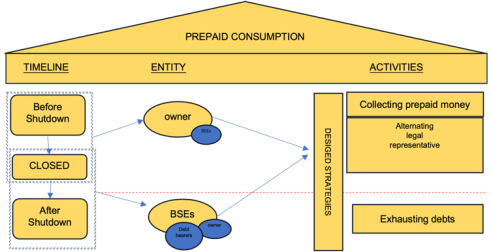
Building upon the visualized operational model of BSEs illustrated below, the following sections will categorize and analyze the potential criminal liabilities of BSEs and related business operators.
2.2.1. Explanation of the Visualized Operational Model of BSEs
Figure 1. Operational Model of Business Shutdown Enforcers.
2.2.2. Criminal Approaches to Eliminate BSEs and Related Entities Based on the Model
Building upon the visualized model of BSEs' operational activities, this section adopts a provision-by-provision approach to explore the potential criminal liability of BSEs and related parties. As the aim of this study is to investigate the criminal regulation of BSEs from a comparative legal perspective, detailed theoretical debates within criminal law will not be extensively discussed. Instead, the focus will be on highlighting critical legal issues arising from the practical application of the relevant offenses.
In applying the crime of fraud, special attention must be paid to the standards for determining "relatively large" and "especially large" (could also be translated as "extraordinarily large") amounts, as they affect the threshold for criminal liability. Additionally, the allocation of criminal responsibility between BSEs, the original store owner, and the "debt bearers" must be analyzed. Whether each party constitutes a principal or an accomplice depends on the specific role and degree of involvement in the fraudulent conduct. Besides, regarding contract fraud, Paragraphs 3 and 4 of Article 224 of the Criminal Law are particularly relevant to the original store owners. The issue of whether BSEs and the original owners should be regarded as co-offenders needs to be evaluated case by case based on their respective actions and agreements. Furthermore, given that the statutory threshold for prosecution is RMB 3,000 for fraud but RMB 20,000 for contract fraud, careful analysis is required to determine which standard governs when the two offenses overlap. Another complex issue lies in how to calculate the value of the defrauded property: whether it should be based on the total value of the prepaid funds collected before closure or on the remaining value of unfulfilled contracts.
Applying Crime of withdrawing the contributed capital can also be considered within the liability scheme. The application of the offense of withdrawing capital contribution appears more indirect. After the intervention of BSEs, it is unlikely that the original owner would have made new capital contributions. However, the possibility of applying this offense to debt bearers who engage in systematic withdrawal of company assets post-shutdown may warrant consideration.
Also, the Crime of obstruction of liquidation is particularly relevant to both BSEs and original owners in the prepaid consumption context. During the shutdown process, if store assets are concealed, falsely reported, or illicitly distributed before outstanding debts are properly settled, serious infringement upon creditors’ rights occurs. In the operational model of BSEs, the intentional design to preemptively dissipate assets, such as transferring assets to debt bearers or rendering the entity judgment-proof, constitutes behavior that may fulfill the objective elements of this offense. Special attention should be paid to the collaborative arrangements between the original owner and BSEs, as both parties could bear criminal liability if their concerted actions lead to harm to creditor interests.
From a broader regulatory perspective, the activities of BSEs can disrupt market order by systematically enabling enterprises to evade lawful debt settlement, deceiving consumers, and undermining fair commercial practices. Pursuant to Paragraph 4 of Article 225, such systemic disruption could qualify or interpretated as illegal business acts. Moreover, considering that the shutdown strategies often involve coordinated actions by BSEs, original owners, and debt bearers, it is important to assess whether their cumulative behaviors amplify the disturbance of market order to a level that satisfies the statutory requirements for this offense. Thus, the potential for BSEs to become an entrenched grey-market industry justifies serious criminal law intervention under this provision.
A critical, though often overlooked, aspect of BSE activities involves the handling of consumer personal information. When original store owners transfer consumer records, including contact information, transaction history, and financial data, to BSEs for the purpose of managing post-shutdown liabilities, it is highly probable that personal information is disclosed or sold without consumer consent. Such conduct directly falls within the scope of Article 253(a) of the Criminal Law, particularly under the second subparagraph addressing violations committed during the performance of duty or provision of services. Therefore, in the governance of BSEs, protecting consumers' personal information and reinforcing criminal accountability for unauthorized data transfers must be emphasized alongside other forms of liability.
Additionally, attention must be paid to the issue of offense concurrence, especially on the question of combining punishments for multiple crimes within each entity. Given the overlapping behaviors and the multiplicity of offenses potentially involved, it is essential to determine the appropriate approach to handling the concurrence of multiple offenses, whether through the application of special provisions, heavier penalties, or case-by-case judicial discretion.
Finally, in considering the application of the criminal offenses analyzed earlier, certain aspects become clearer when reviewing the operational model of BSEs. Particularly from the subjective element perspective of criminal liability, evidence could readily demonstrate that the involved parties possessed explicit knowledge and deliberate intent (mens rea) to commit these offenses. Therefore, combining the previously visualized operational model with the offense-specific analyses enhances clarity regarding the constituent elements necessary to establish criminal liability against BSEs.
3. Similar Entities and Issues Across Jurisdictions: The Approaches to Address Them
This section adopts a comparative perspective to explore regulatory approaches toward entities analogous to Business Shutdown Enforcers (BSEs) in jurisdictions outside China. It comprises two distinct but interrelated components. First, it examines how other countries address similar groups, particularly aggressive debt collectors, under their respective legal, especially criminal law frameworks, aiming to identify insights and approaches China could potentially adopt in tackling BSEs. Second, recognizing that such entities operate within legal grey areas, the discussion further extends to a briefer yet broader exploration of regulatory strategies employed globally when confronting these ambiguously lawful groups. This analysis involves examining the conditions under which criminal law should intervene and considering the appropriate limits and boundaries of such criminal regulation.
3.1. Solutions to Regulate Entities Similar to Business Shutdown Enforcers
In jurisdictions such as the United States and the United Kingdom, fraudulent activities related to prepaid consumption have received legislative attention. United States federal law considering wire fraud and mail fraud, listed intention as one of the factors. If an individual or entity accepts advance payments for goods or services with no intention of delivering them, then prepayment schemes can lead to criminal liability under statutes addressing fraud. Similarly in UK, prepayment-related misconduct is primarily addressed through the Fraud Act 2006. Accepting advance payments without the intention to supply goods or services can amount to fraud by false representation as well. Additionally, under the Digital Markets, Competition and Consumers Act 2024 (DMCC Act), such conduct may be considered a misleading information which may constitute unfair commercial practices, leading to both criminal and civil penalties. Although the exact counterparts to China's BSEs may not exist, the closest comparable entities identified are aggressive debt collectors in UK and US jurisdictions. Aggressive debt collectors can be generally defined as entities that employ coercive, intimidating, or harassing methods to recover debts, or abusing the right to collect debt with any and all kinds of violent behaviors.
In the United States, the Federal Fair Debt Collection Practices Act (FDCPA) explicitly sets limitations on debt collectors' conduct. This legislation outlines specific behaviors constituting harassment, as well as practices considered false, deceptive, or misleading in debt collection. Similarly, UK legislation provides explicit definitions of creditor behavior qualifying as harassment in debt collection process. Due to the inherently coercive or violent nature embedded in the definition of aggressive debt collectors, applying criminal liability frameworks to their conduct is naturally appropriate and justified. Insights for China's regulatory approach toward BSEs drawn from these jurisdictions include the direct applicability of criminal law when violence or threats are employed, despite such cases being relatively uncommon. Another perspective emerges when considering available evidence, such as written or verbal agreements between BSEs and business owners or managers, that clearly demonstrates a lack of intention to fulfill debt obligations. Such documentation can effectively establish criminal intent and facilitate prosecution under specific criminal offenses.
Moreover, in the U.S., the Consumer Financial Protection Bureau (CFPB) operates a publicly accessible Real-Time Debt Collection Complaint Database
, documenting businesses repeatedly involved in unlawful debt-collection activities. China's regulatory system addressing BSEs could similarly benefit from a comparable public disclosure mechanism. For instance, individuals repeatedly identified as BSEs (or their accomplices), especially those involved in criminal conduct, could be incorporated into a multi-departmental memorandum of cooperation
for joint disciplinary action. Although current social credit systems primarily address breaches of civil and commercial obligations, introducing individuals into an official "blacklist" with specific remarks such as suspected of "certain criminal behavior(s)" could effectively deter individuals from continuing or participating in BSEs activities. It is also essential to fully leverage the social credit system while adhering to the institutional boundaries governing dishonesty sanctions when regulating BSEs operations
| [12] | Wenhua, W. Clarifying the Scope and Limits of Dishonesty Sanctions to Prevent Overgeneralization in Institutional Governance (Jiejue Shixinchengjiefanhuawenti Xv Liqing Zhidu Bianjie), People’s Tribune. 2021, (04), 86-88. |
[12]
.
Shifting the comparative perspective back to Asia, the regulatory experience of South Korea provides a valuable point of reference. In October 2021, DuPont Korea abruptly suspended operations at its W&P division in Ulsan, resulting in the immediate layoffs of nearly 60 employees, almost all of whom were union members
. The affected trade union alleged that the closure was strategically aimed at dissolving union influence. The South Korean court subsequently ruled that these layoffs constituted unfair dismissal, highlighting the importance of responsible business closures and the protection of employee rights.
This scenario emphasizes a critical alert for China's regulation of BSEs: the necessity of preventing BSE-like entities from applying similar strategic closures to larger-scale enterprises. Should BSEs begin formulating shutdown or debt-transfer strategies for sizable businesses, the impacted stakeholders and infringed legal interests would become substantially more complex. From the perspective of criminal law, if such a scenario arises, China's existing legal framework could consider criminal charges against company personnel for the Crime of withdrawing the contributed capital. However, since the subject of this specific offense is limited by law exclusively to company shareholders or founders, BSEs themselves would not satisfy the identity criteria required for this charge. Alternatively, criminal law might contemplate joint trials involving corporate (unit) offenses committed by the company and separate but related offenses committed by individual BSEs, thereby providing a comprehensive legal approach to address such complex cases
| [14] | Chinese Academy of Social Sciences. Judicial thinking on the concurrence of entity crime and individual crime: With a discussion on innovative approaches to joint trials (Danweifanzui Yu Tazuizeren Zhutijinghede Shenli Silu). Available from:
http://iolaw.cssn.cn/fxyjdt/201601/t20160129_4638485.shtml (accessed 13 April 2025). |
[14]
.
The above comparative studies illustrate that while BSEs are unique to China, similar challenges exist globally. Jurisdictions like the U.S. and U.K. criminalize coercive debt collection, while South Korea’s DuPont case underscores the societal harm of irresponsible shutdowns. These examples reveal the limitations of purely civil responses and support the necessity of criminal law intervention. Together, they offer valuable insights for China’s approach to regulating BSEs through a hybrid model that combines punitive, preventive, and reputational mechanisms.
3.2. Solutions to Regulate Similar Organized Groups
When Business Shutdown Enforcers (BSEs) emerge as a loosely defined profession and social group, their regulation poses challenges beyond conventional civil or criminal liability. Although BSEs do not exhibit overtly violent or organized criminal traits, their persistent, profit-oriented structure
| [15] | Zhang, J., & Xiao, F. (2024, November 21). Why have “professional store closers” become rampant? “Packaging” debt transfer may constitute fraud. Sanxiang Metropolis Daily, A08. |
[15]
and recurring patterns of evading legal obligations warrant examination through the lens of organized group governance. A comparative exploration of how other jurisdictions regulate criminal groups sheds light on the limits and potentials of criminal law’s role in managing such gray-area actors.
Notably, the Italian Mafia and Japan’s Yakuza represent classic models of organized crime syndicates that have historically been addressed through criminal law with a strong focus on dismantlement and deterrence. Mafia OCGs (officially called as Mafia-Structured Organized Crime Groups,) are groups of highly structured and hierarchical organized individuals who originates primarily from Italy
. Yakuza, similarly, is Japan’s regulated organized crime groups, known for structured operations and public violence
. However, recent practices imply a possible shift toward selective civil enforcement, asset freezing, and reputational containment, usually observed as a reverse escalation, wherein the governance of criminal organizations partially reverts to regulatory, administrative, or civil mechanisms. This approach acknowledges that full-scale criminal prosecutions, while symbolically powerful, may be inefficient or ineffective when applied indiscriminately or without systemic support. For instance, the comparative experience with legally registered Mafia firms (LMFs) in Italy offers an instructive framework. Their existence reveals how legal form can conceal systemic illegality, making them difficult to regulate through criminal law alone. In these cases, Mafia families deploy internal governance mechanisms, including violence, corruption, affiliate and firm turnover, to evade scrutiny and neutralize both internal moral hazards and external regulatory efforts
| [18] | Duplat, V., Very, P., & Monnet, B. (2012). Identification and Economic Analysis of Governance Mechanisms in Legally Registered Mafia Firms. M@n@gement, 15(3), 273-282. |
[18]
. This has led to a shift in some jurisdictions toward hybrid or de-escalated enforcement strategies, including asset seizure, reputational exposure, and administrative disqualification
| [18] | Duplat, V., Very, P., & Monnet, B. (2012). Identification and Economic Analysis of Governance Mechanisms in Legally Registered Mafia Firms. M@n@gement, 15(3), 273-282. |
[18]
, thereby reducing reliance on high-cost criminal trials.
For China, this inversion of regulatory logic offers critical insights. While BSEs are not traditional criminal organizations, their potential to institutionalize deceptive business shutdowns on a large scale demands a calibrated legal response. Criminal law may still function as a final safeguard
| [19] | Yanhong, L. Theoretical adaptation of criminal law to societal development: Five critical relationships to be managed (Xingfa Lilun Yin Yingshidaifazhan Xu Chulihao Wuzhongguanxi). Oriental Law, 6-19. |
[19]
, yet sustainable regulation requires layered approaches. Thus, understanding how other jurisdictions manage complex, loosely structured groups can help Chinese law determine not only when to escalate to criminal law, but also when and how, to strategically de-escalate, governing through hybrid or preventive measures rather than hard punishment itself.
4. Conclusions
The emergence of Business Shutdown Enforcers (BSEs) represent a relatively new, yet concerning phenomenon within contemporary social and economic governance. This emerging ''profession'', which occupies a legal and operational grey area, is increasingly viewed as problematic, particularly given its impact on the broader mechanisms of societal governance. Specifically, the operational modes employed by BSEs negatively influence the credibility and functionality of established systems such as the social credit systems and the existing legal framework, thus eroding public trust and increasing the overall costs associated with legal and administrative interventions designed to regulate such activities.
To effectively govern socially distinctive groups like BSEs, it is crucial to develop an in-depth understanding of their underlying operational frameworks. Only by systematically analyzing and dissecting each stage of their activities can targeted, efficient, and enforceable governance legal mechanisms be crafted. This comprehensive stage-by-stage analytical approach allows regulatory and enforcement bodies to identify vulnerabilities and strategically intervene at crucial points, thereby maximizing regulatory efficiency and reducing the potential for legal evasion by these actors.
Furthermore, anticipating the possibility of similar groups emerging in the future, policymakers and enforcement authorities, especially within the Chinese jurisdiction, should place greater emphasis on integrating civil and criminal legal instruments into governance strategies. This integration requires careful consideration of both the appropriate degree of legal intervention and clear delineation of the boundaries between civil and criminal approaches. Additionally, jurisdictions beyond China, while respecting their unique legal traditions and governance frameworks, can benefit from the comparative analysis of China’s experience. Adopting and adapting integrated civil-criminal governance models can potentially enhance their ability to address analogous phenomena effectively, demonstrating a balanced yet robust approach to managing grey-area activities that threaten social and economic stability in a legally-appropriate way.






 Share This Article
 Twitter
 Linked In
 Facebook
 Copy
Copy Download